
2 min read
Autonomous AI Agent for End-to-End Component Data Extraction
1. Objective Streamline complex, error-prone manual data entry Reallocate engineering talent to high-value innovation Achieve end-to-end automation...
1 min read
Press
Updated on August 4, 2025
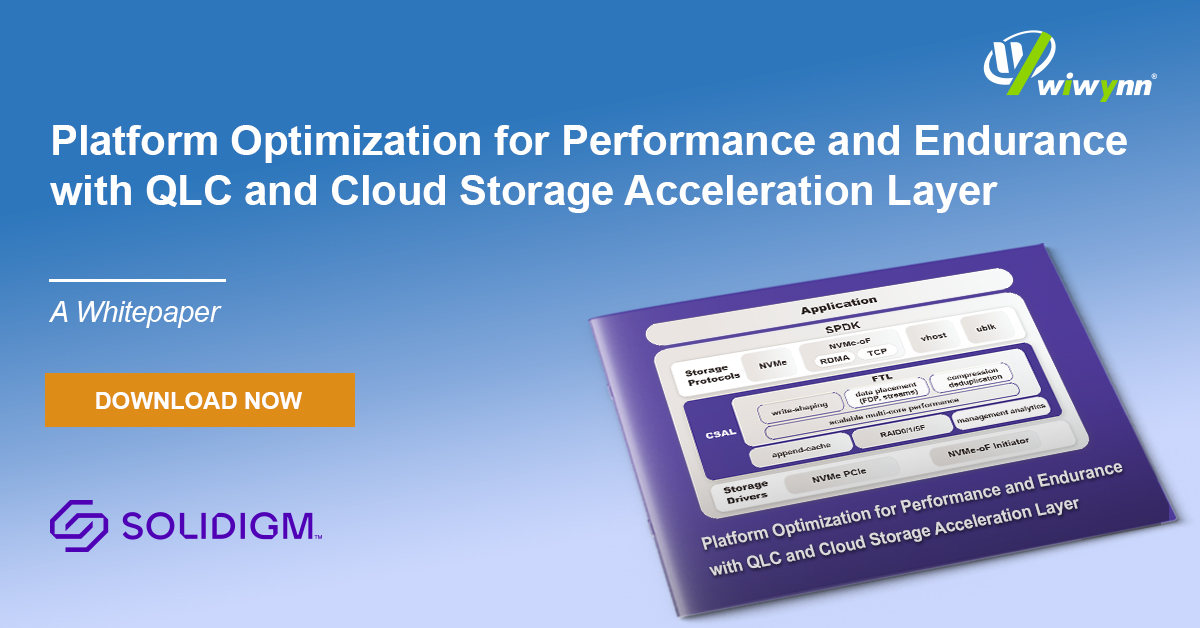
High-density QLC SSDs are redefining storage architectures and are paving the way for greater data density and cost and power efficiency. They are breaking the traditional 4 KiB assumptions that have shaped today’s storage stacks. QLC technology introduces unique characteristics such as larger indirection units and require rethinking the write accesses to the SSDs. Optimizations are required to help ensure that the increased capacity of QLC drives contributes positively to total cost of ownership (TCO), endurance, and efficiency, even as capacities scale toward 122.88 TB and beyond.
Cloud Storage Acceleration Layer (CSAL) offers the required optimization by moving a lightweight FTL into the host and fronting QLC with a fast cache tier. Writes land first on SLC/TLC (formerly Optane) media, then flush to QLC as large, sequential blocks, driving WAF down to ~1 while preserving flash endurance and making the high write performance of SLC/TLC drives available to the host. The approach delivers SSD-class throughput, eight-times density per slot, and requires zero changes to the 4 KiB-optimized host software stack.
To prove the model, Solidigm partnered with Wiwynn, pairing a Gen5 D7-PS1010 TLC cache with 61.44 TB D5-P5336 QLC drives in production-ready Wiwynn platforms. Mixed-workload testing across AMD and Intel servers hit NAND-saturating bandwidth, maintained QoS at 90 % fill, and slashed watt-per-TB metrics—validating CSAL as a turnkey path for hyperscalers and enterprises to adopt ultra-dense flash without compromising performance or budget.
Register now to download the full white paper and accelerate your path to ultra-dense flash.
2 min read
1. Objective Streamline complex, error-prone manual data entry Reallocate engineering talent to high-value innovation Achieve end-to-end automation...
1 min read
Deploying large-scale AI clusters introduces engineering challenges that extend well beyond the individual server rack. From liquid cooling...
1 min read
This paper discusses the rapid expansion of AI workloads and the resulting transformation in data center infrastructure requirements. Traditional...