White Paper: High-Power Double-Wide Rack
This white paper presents a complete design and validation framework for next-generation high-power double-wide racks....
As Generative AI pushes compute demands beyond physical limits, server power architecture is undergoing a system-level revolution. As rack power density accelerates from 20 kW to beyond 100 kW—and with proposals reaching up to 1 MW, power architecture has become the critical backbone of AI computational performance.
Wiwynn’s Strategic Pillar: Core Technologies Defining Hyperscale Compute
As AI accelerator currents exceed 1,000A, traditional lateral power delivery hits a "Power Wall" of prohibitive voltage drops. Vertical Power Delivery (VPD) solves this by mounting conversion modules directly beneath the processor.
• Path Loss Mitigation: Ultra-short vertical paths slash PDN I2R losses by >80% at high-current AI loads.
• Architectural Freedom: Backside delivery frees up the top-side PCB for additional HBM (High Bandwidth Memory) or reduced form-factor designs.
• Voltage Integrity: Ultra-low inductance minimizes voltage droop during extreme load transients, protecting signal integrity.
• Thermal Optimization: By minimizing resistance-induced heat, VPD enhances the overall effectiveness of liquid cooling loops.
The transition to Modular Rack-Level Power is essential for AI elasticity. Our integrated architecture—featuring centralized busbars and intelligent power shelves—delivers the high-availability redundancy required for absolute stability under extreme transient AI workloads.
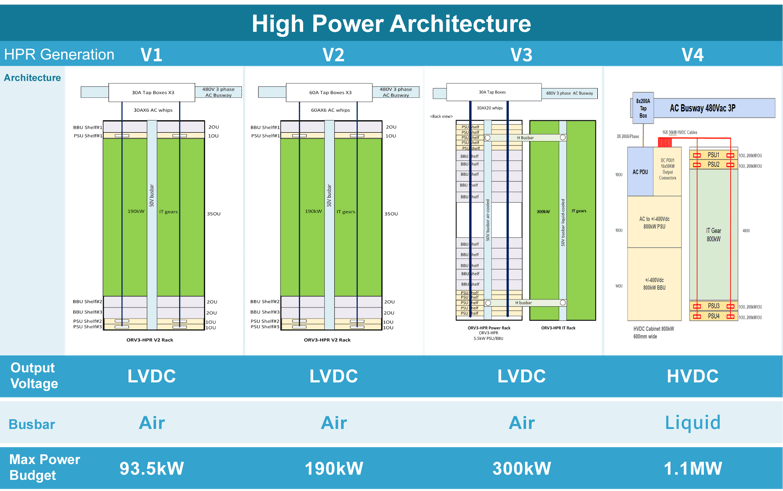
• Exponential Capacity Scaling: Seamlessly scaling from 190kW (V2) to 300kW (V3), and reaching a massive 1.1MW (V4) to meet the most demanding AI training clusters.
• Disaggregated Topology: Evolving from single-rack integration to disaggregated Power Racks and IT Racks (V3/V4), enabling modular deployment and superior data center floor-plan flexibility.
• Advanced HVDC Transmission: Transitioning to ±400VDC or 800V architectures to neutralize transmission losses and maximize end-to-end energy efficiency.
• Dynamic Transient Response: Engineered for the "bursty" nature of AI workloads, utilizing Capacitor Backup Units (CBU) to ensure seamless voltage stability during rapid compute load fluctuations.
We are redefining power delivery by leveraging SiC/GaN semiconductors and Digital Twin insights. This architecture achieves deep synergy with advanced liquid cooling solutions, creating a "smart" energy chain for the entire AI infrastructure.
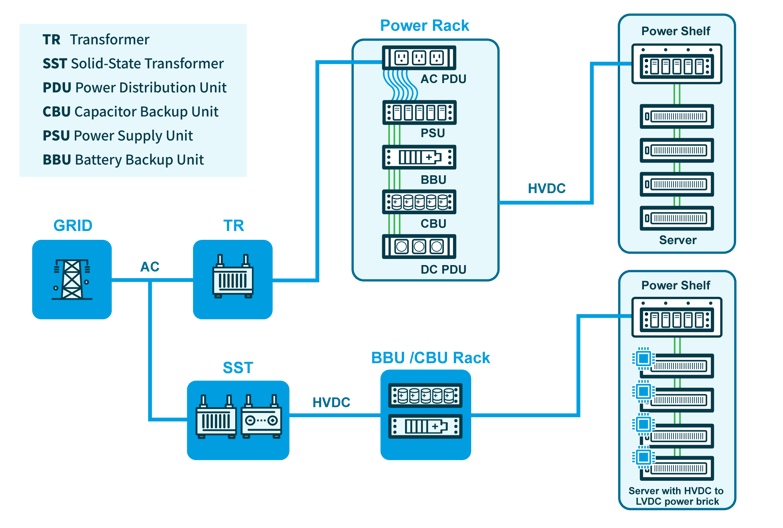
• Centralized Power Nodes: The Power Rack acts as the intelligence hub, converting grid-scale AC to stable HVDC. Integrated BBU/CBU energy storage provides a robust backup buffer, reducing server-level complexity.
• Solid-State Transformer (SST): Our SST technology provides a high-density alternative to traditional bulky transformers. By converting power directly to HVDC at the facility level, SSTs offer superior control flexibility and modular scalability for rapid hyperscale deployment.