
1 min read

White Paper: Innovative Two-Phase Cold Plate Solutions for Future High-Power AI Chips

White Paper: Innovative Two-Phase Cold Plate Solutions for Future High-Power AI Chips
1:20

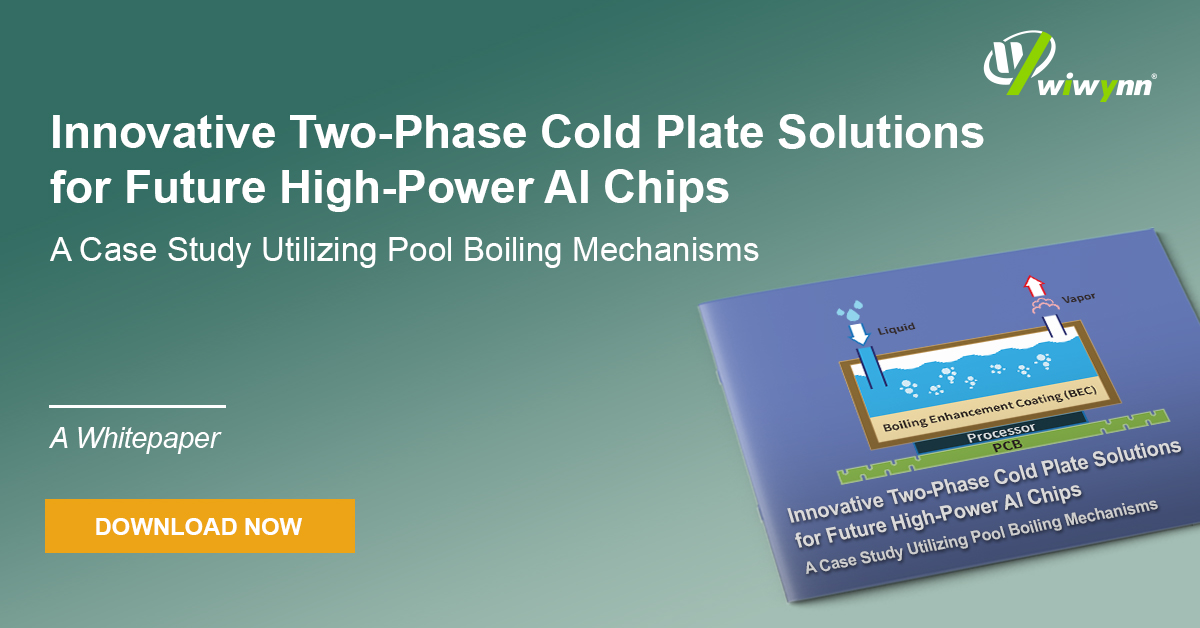
AI accelerators and next-gen HPC processors are already nudging past the one-kilowatt mark, making single-phase liquid loops struggle with soaring flow rates, pump power, and rack-level energy budgets. Our latest white paper reveals how a two-phase cold plate, tuned for a 45 °C boiling point, evacuates up to 2.5 kW from a die area while holding junction temperatures flat—even when power density climbs to 125 W/cm². The result is cooler silicon, fewer hotspots, and headroom for faster clocks in dense AI deployments.

Inside you will find head-to-head lab data that pits this pool-boiling design against conventional single-phase plates across single- and multi-socket testbeds. Detailed charts document a 13.7 °C CPU temperature drop, pump-power cuts of roughly sixty-seven percent, and stable performance at just 0.85 L min⁻¹ coolant flow. The paper also walks through refrigerant selection, manifold layout, and pressure-drop mitigation so system architects can adopt low-GWP fluids without sacrificing thermal margin or uptime.

Do not let thermal ceilings choke the next wave of AI chips. Download the full white paper today and map out a two-phase strategy that boosts performance, slashes operating power, and future-proofs your cooling stack.

White Paper: GPU-Initiated, Liquid-Cooled, Ultra-High-Density Storage for Next-Gen AI

1 min read

White Paper: GPU-Initiated, Liquid-Cooled, Ultra-High-Density Storage for Next-Gen AI

This paper introduces a paradigm shift in storage architecture designed to overcome the CPU-centric data path bottlenecks in modern AI workloads. By...

Read More
White Paper: KV Cache Offload to Improve AI Inferencing Cost and Performance

1 min read

White Paper: KV Cache Offload to Improve AI Inferencing Cost and Performance

This paper explores a disaggregated key-value (KV) storage architecture designed to efficiently offload KV cache tensors for generative AI workloads.

Read More
Autonomous AI Agent for End-to-End Component Data Extraction

1 min read

Autonomous AI Agent for End-to-End Component Data Extraction

This paper explores an advanced framework designed to automate the extraction of important attributes from unstructured part datasheets. By...

Read More